 PDF
Water-Break Technology Serum as the Innovative Texture for Sensitive Skin People in Tropical Climates with Excellent Efficacy
Istiqomah N., Utami D., Pinastika H.L., Mulya S.N.
Laboré Skin Research and Innovation Center
Abstract
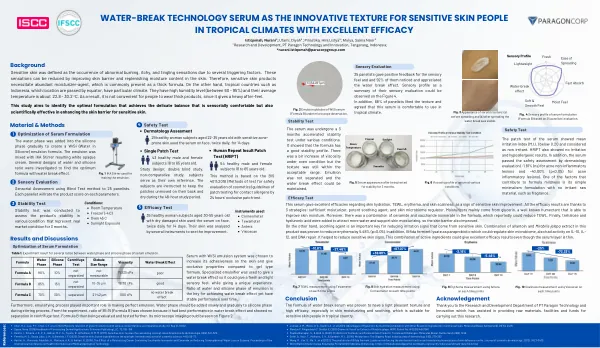
Sensitive skin products typically rely on thick, occlusive formulas that are uncomfortable in humid tropical climates. This study developed a lightweight water-break serum evaluated across sensory, stability, safety and efficacy testing, showing improved skin hydration and barrier function (reduced TEWL, erythema and scaliness) with a fresh, fast-absorbing texture.
Key findings
- Formula B at an 85:15 water to silicone ratio was selected for the best water-break effect with no separation in the centrifuge test
- Erythema reduced 5.48% (p<0.05) through the combination of allantoin and Mirabilis jalapa extract
- Inflammatory acne lesions reduced 40.00% (p<0.05) in dermatological evaluation
- Mean irritation index below 0.20, classified non-irritant, with no irritation and hypoallergenic results in HRIPT
- 92% of 25 panelists noticed the water-break effect and 88% agreed the serum is comfortable in a tropical climate
Methods at a glance
- Participants
- 35 healthy women, 30 to 55 years old, with dry damaged skin
- Application
- Twice daily on the face for 14 days
- Instruments
- Corneometer, Tewameter, Antera and Visioscan
- Sensory panel
- 25 panelists; 92% noticed and appreciated the water break effect, 88% liked the texture and agreed the serum is comfortable in a tropical climate
- Emulsion system
- Water-in-silicone emulsion prepared with an IKA stirrer and a specialized emulsifier
- Stability
- 3-month accelerated testing at room temperature, freezer at -4 C, oven at 45 C and sunlight exposure
- Safety
- Patch test mean irritation index below 0.20 and classified non-irritant; HRIPT showed no irritation and hypoallergenic results
Data from the poster
Values reproduced as printed in the source document.
| Formula | Water phase | Silicone phase | Centrifuge test | Globule size range | Viscosity | Water break effect |
|---|---|---|---|---|---|---|
| Formula A | 90% | 10% | Not separated | Not measurable | 75,330 cPs | Poor |
| Formula B | 85% | 15% | Not separated | 10 to 35 μm | 19,170 cPs | Good |
| Formula C | 70% | 30% | Separated | 21 to 42 μm | 1,100 cPs | No water break effect |
| Parameter | Instrument | Baseline | Day 7 | Day 14 |
|---|---|---|---|---|
| Transepidermal water loss | Tewameter | 12.78 | 11.40 | 9.27 |
| Skin hydration | Corneometer | 21.42 | 29.75 | 40.07 |
| Erythema | Antera | 34.32 | 33.58 | 32.44 |
| Skin scaliness | Visioscan | 0.52 | 0.39 | 0.30 |
Background
Sensitive skin is defined as the occurrence of abnormal burning, itching and tingling sensations due to several triggering factors. These sensations can be reduced by improving the skin barrier and replenishing moisture content in the skin. Sensitive skin products therefore need an abundant moisturizer agent, which is commonly delivered in a thick formula. On the other hand, tropical countries such as Indonesia, which sits on the equator, have a particular climate with high humidity between 60% and 95% and an average temperature of about 22.8 to 30.2°C. As a result it is not convenient for people to wear thick products, since they leave a heavy after-feel.
Objective
To identify the optimal formulation that achieves the delicate balance of being sensorially comfortable while remaining scientifically effective in enhancing the skin barrier for sensitive skin.
Materials and methods
The water phase was added gradually into the silicone phase to create a water-in-silicone (W/Si) emulsion, mixed with an IKA stirrer to produce a white opaque cream. Several water to silicone ratios were investigated to find the optimum formula with a water-break effect. Sensorial assessment used a blind test with 25 panelists rating the product on each parameter. Stability testing ran for 3 months at room temperature, in a freezer at -4°C, in an oven at 45°C and under sunlight exposure. Safety testing covered a single patch test in 43 healthy male and female subjects aged 18 to 65 using a double-blind, non-comparative design over a 48-hour period, a Human Repeat Insult Patch Test in 54 healthy subjects aged 18 to 65 based on BIS 4011:2018 guidelines, and dermatology assessment in 29 healthy women aged 22 to 35 with sensitive acne-prone skin who used the serum twice daily for 14 days. The efficacy test involved 35 healthy women aged 30 to 55 with dry damaged skin who used the serum on the face twice daily for 14 days, analysed with Corneometer, Tewameter, Antera and Visioscan.
Results and discussion
A water-in-silicone emulsion system was chosen to increase adhesiveness on the skin and give occlusive properties compared with a gel-type formula, and a specialised emulsifier was used to create the water-break effect for a fresh, light sensory feel. The ratio of water to silicone phase is the key to achieving the water-break effect while maintaining stable performance over time. Formula A at 90:10 gave poor water-break effect with a viscosity of 75330 cPs, Formula C at 70:30 separated in the centrifuge test, and Formula B at 85:15 was chosen because it had the best water-break performance, a globule size range of 10 to 35 μm, a viscosity of 19170 cPs and no separation in the centrifuge test. In sensory evaluation, 25 panelists gave positive feedback, 92% noticed and appreciated the water-break effect and 88% liked the texture and agreed the serum is comfortable to use in a tropical climate. The 3-month accelerated stability test showed a good stability profile, with a slight increase in viscosity under oven conditions that remained within the acceptable range, no emulsion separation and a maintained water-break effect. The patch test showed a mean irritation index below 0.20 and the serum was considered non-irritant, while HRIPT showed no irritation and hypoallergenic results. Dermatology evaluation recorded -1.81% (not significant) for non-inflammatory acne lesions and -40.00% (p<0.05) for inflammatory acne lesions. The serum gave excellent efficacy for skin hydration, TEWL, erythema and skin scaliness. These results come from three strategies: sufficient moisturizer, a potent soothing agent and a skin microbiome regulator. Moisturizers come mainly from glycerin, with a combination of ceramide and saccharide isomerate reported to reduce TEWL, plus trehalose and hyaluronic acid to attract more water. The combination of allantoin and Mirabilis jalapa extract was proven to reduce erythema by 5.48% (p<0.05), and Bifida ferment lysate as a paraprobiotic regulates the skin microbiome with activity on IL-10, IL-12 and DNA repair.
Conclusion
The water-break serum formula was proven to have a light, pleasant texture and high efficacy, especially in skin moisturizing and soothing, making it suitable for people with sensitive skin in tropical countries.
References
Literature cited by the authors on the source poster.
- 1.Chen, H.J., Lee, P.Y., Chen, C.Y. et al. (2022). Moisture retention of glycerin solutions with various concentrations: a comparative study. Scientific Reports 12, 10232.
- 2.Dayan, N. (2016). Handbook of Formulating Dermal Applications. Scrivener Publishing LLC. 72, 155-156.
- 3.Duarte, I., Silveira, J.E.P.S., Hafner, M.F.S., Toyota, R. & Pedroso, D.M.M. (2017). Sensitive skin: review of an ascending concept. Anais Brasileiros de Dermatologia 92(4), 521-525.
- 4.Ferreira, M.S., Sousa Lobo, J.M. & Almeida, I.F. (2022). Sensitive skin: active ingredients on the spotlight. International Journal of Cosmetic Science 44(1), 56-73.
- 5.Hartini, H., Vlorensia, Abdullah, H., Martinus, A.R. & Ikhtiari, R. (2019). The effect of a moisturizing cream containing saccharide isomerate and ceramide on reducing transepidermal water loss in eczema. Proceedings of the International Conference on Health Informatics and Medical Application Technology.
- 6.Juncan, A.M., Moisă, D.G., Santini, A., et al. (2021). Advantages of hyaluronic acid and its combination with other bioactive ingredients in cosmeceuticals. Molecules (Basel) 26(15), 4429.
- 7.Mondon, P., Ringenbach, C. & Doridot, E. (2015). Cosmetic use of an extract of Mirabilis jalapa. WIPO Patent No. WO2015140679A1.
- 8.Puebla-Barragan, S. & Reid, G. (2021). Probiotics in cosmetic and personal care products: trends and challenges. Molecules (Basel) 26(5), 1249.
- 9.Sethi, A., Kaur, T., Malhotra, S.K. & Gambhir, M.L. (2016). Moisturizers: the slippery road. Indian Journal of Dermatology 61(3), 279-287.
- 10.Wang, R., Yan, S., Ma, X., et al. (2023). The pivotal role of Bifida ferment lysate on reinforcing the skin barrier function and maintaining homeostasis of skin defenses in vitro. Journal of Cosmetic Dermatology 22(12), 3427-3435.
- 11.World Bank Climate Change Knowledge Portal (2021). Indonesia climatology. https://climateknowledgeportal.worldbank.org/country/indonesia/climate-data-historical
Acknowledgement
Thank you to the Research and Development Department of PT Paragon Technology and Innovation, which provided raw materials, facilities and funds for carrying out this research.