 PDF
Comprehensive Microbiome Evaluation of Gentle Cleanser and Moisturizer with Prebiotic, Paraprobiotic, Probiotic and Postbiotic Actives as Non-Prescription Alternative for Atopic Dermatitis Treatment
Zahratunnisa H., Utami D., Christianti M.A., Safitri A.F., Utami S.T., Hendra A., Fajrin A.
Abstract
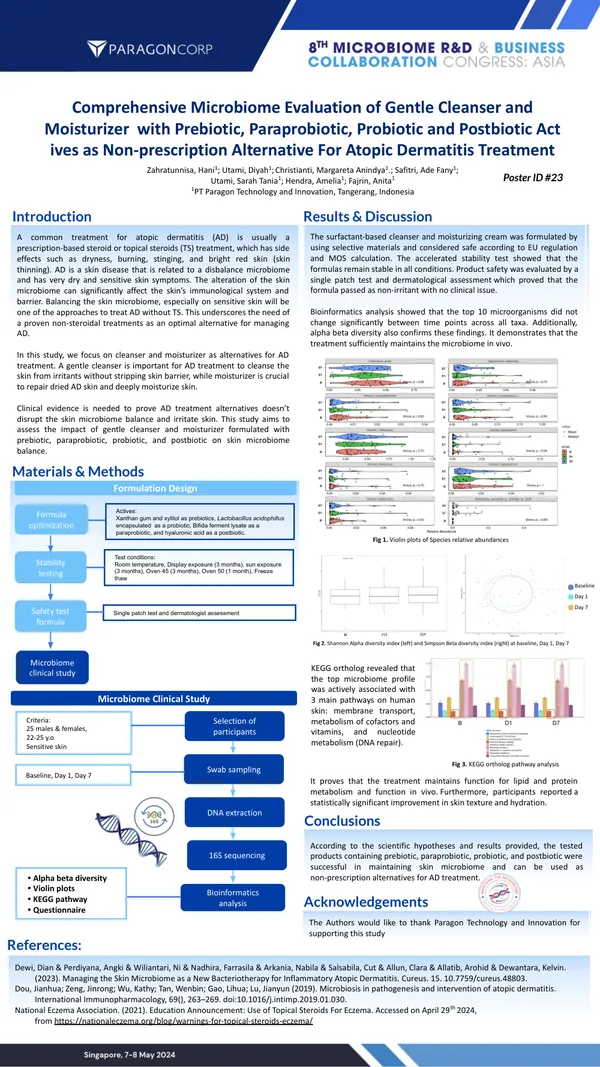
A gentle surfactant-based cleanser and moisturizing cream formulated with prebiotic, paraprobiotic, probiotic and postbiotic actives, evaluated as a non-prescription alternative for atopic dermatitis. The formulas passed stability and non-irritant safety testing, and bioinformatics analysis of the skin microbiome showed the top microorganisms and alpha/beta diversity stayed stable across timepoints, indicating the products maintain a balanced microbiome in vivo while supporting lipid and protein metabolism.
Key findings
- Top 10 microorganisms showed no significant change between baseline, Day 1 and Day 7 across all taxa
- Shannon alpha diversity and Simpson beta diversity confirmed the microbiome was maintained in vivo
- KEGG ortholog analysis linked the microbiome profile to membrane transport, metabolism of cofactors and vitamins, and nucleotide metabolism (DNA repair)
- Passed single patch test and dermatological assessment as non-irritant with no clinical issue
- Participants reported a statistically significant improvement in skin texture and hydration
Methods at a glance
- Participants
- 25 male and female subjects, 22 to 25 years old
- Skin type
- Sensitive skin
- Sampling points
- Baseline, Day 1, Day 7
- Method
- Swab sampling, DNA extraction, 16S rRNA sequencing, bioinformatics analysis
- Analyses
- Alpha and beta diversity, violin plots of species relative abundance, KEGG pathway analysis, questionnaire
- Actives
- Xanthan gum and xylitol as prebiotics, encapsulated Lactobacillus acidophilus as probiotic, Bifida ferment lysate as paraprobiotic, hyaluronic acid as postbiotic
- Stability conditions
- Room temperature, display exposure 3 months, sun exposure 3 months, oven 45 C for 3 months, oven 50 C for 1 month, freeze thaw
- Safety
- Single patch test and dermatologist assessment
Background
A common treatment for atopic dermatitis is prescription-based steroid or topical steroid treatment, which carries side effects such as dryness, burning, stinging and bright red skin from skin thinning. Atopic dermatitis is a skin disease related to a disbalanced microbiome, presenting with very dry and sensitive skin symptoms. Alteration of the skin microbiome can significantly affect the skin's immunological system and barrier, so balancing the skin microbiome, especially on sensitive skin, is one approach to treating atopic dermatitis without topical steroids. This underscores the need for proven non-steroidal treatments as an optimal alternative. This study focuses on a cleanser and a moisturizer as alternatives. A gentle cleanser is important to cleanse the skin of irritants without stripping the skin barrier, while a moisturizer is crucial to repair dried skin and deeply moisturize.
Objective
To assess the impact of a gentle cleanser and moisturizer formulated with prebiotic, paraprobiotic, probiotic and postbiotic actives on skin microbiome balance, providing the clinical evidence needed to show that an atopic dermatitis treatment alternative does not disrupt microbiome balance or irritate the skin.
Materials and methods
Actives were xanthan gum and xylitol as prebiotics, encapsulated Lactobacillus acidophilus as a probiotic, Bifida ferment lysate as a paraprobiotic and hyaluronic acid as a postbiotic. Stability testing covered room temperature, display exposure and sun exposure for 3 months, an oven at 45°C for 3 months and 50°C for 1 month, and freeze thaw cycles. Safety was assessed by single patch test and dermatologist assessment. The microbiome clinical study enrolled 25 male and female participants aged 22 to 25 with sensitive skin. Swab sampling was performed at baseline, Day 1 and Day 7, followed by DNA extraction and 16S sequencing. Bioinformatics analysis covered alpha and beta diversity, violin plots, KEGG pathway analysis and a participant questionnaire.
Results and discussion
The surfactant-based cleanser and moisturizing cream were formulated with selective materials and considered safe according to EU regulation and margin of safety calculation. Accelerated stability testing showed the formulas remained stable in all conditions, and safety evaluation by single patch test and dermatological assessment proved the formulas passed as non-irritant with no clinical issue. Bioinformatics analysis showed the top 10 microorganisms did not change significantly between timepoints across all taxa, and alpha and beta diversity confirmed these findings, demonstrating that the treatment sufficiently maintains the microbiome in vivo. KEGG ortholog analysis revealed that the top microbiome profile was actively associated with three main pathways on human skin: membrane transport, metabolism of cofactors and vitamins, and nucleotide metabolism for DNA repair. This shows that the treatment maintains function for lipid and protein metabolism in vivo. Participants also reported a statistically significant improvement in skin texture and hydration.
Conclusion
The tested products containing prebiotic, paraprobiotic, probiotic and postbiotic actives were successful in maintaining the skin microbiome and can be used as non-prescription alternatives for atopic dermatitis treatment.
References
Literature cited by the authors on the source poster.
- 1.Dewi, D., Perdiyana, A., Wiliantari, N., Nadhira, F., Arkania, N., Salsabila, C., Allun, C., Allatib, A. & Dewantara, K. (2023). Managing the skin microbiome as a new bacteriotherapy for inflammatory atopic dermatitis. Cureus 15. doi:10.7759/cureus.48803.
- 2.Dou, J., Zeng, J., Wu, K., Tan, W., Gao, L. & Lu, J. (2019). Microbiosis in pathogenesis and intervention of atopic dermatitis. International Immunopharmacology 69, 263-269. doi:10.1016/j.intimp.2019.01.030.
- 3.National Eczema Association. (2021). Education announcement: use of topical steroids for eczema. Accessed 29 April 2024, from https://nationaleczema.org/blog/warnings-for-topical-steroids-eczema/
Acknowledgement
The authors would like to thank Paragon Technology and Innovation for supporting this study.