 PDF
Validity, Reliability, and Comparison of the Indonesian Version of Two Baumann Skin Type Indicator (BSTI) Questionnaires
Batubara I.S., Sitohang I.B.S., Widaty S., Nilasari H., Kekalih A., Chairunnisa S.
Department of Dermatology and Venereology, Faculty of Medicine, Universitas Indonesia - Dr. Cipto Mangunkusumo Hospital
Abstract
Skin type assessment in Indonesia has relied on the Fitzpatrick phototype, which captures UV response but little else. This study translated, culturally adapted and validated both the 64-item 2006 and the simplified 7-item 2022 Baumann Skin Type Indicator in 150 Indonesian adults, establishing the first validated multidimensional skin-typing tool for the population and the scientific foundation for personalised skincare across all skin types.
Key findings
- 150 Indonesian adults aged 18–59 with Fitzpatrick skin types III–V completed both questionnaire versions
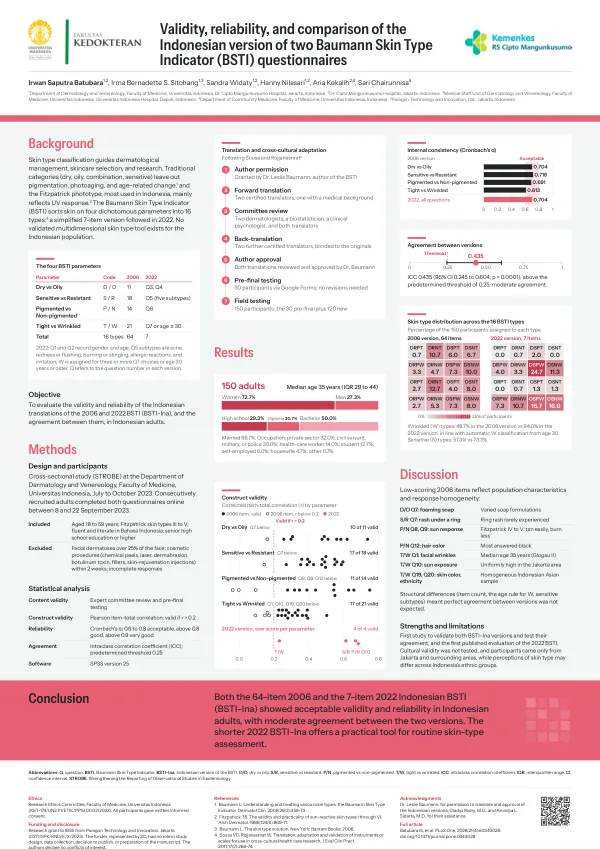
- Cronbach's alpha 0.613–0.718 across the four domains of the 2006 BSTI-Ina and 0.704 for the 2022 version, all within the acceptable range
- Construct validity ranged from −0.037 to 0.751 for the 2006 version; every item in the 2022 version cleared the r > 0.2 threshold at 0.231–0.685
- Agreement between versions: ICC 0.435 (95% CI 0.245–0.604; p = 0.0001), above the predetermined threshold of 0.25
- First study in any population to evaluate the 2022 BSTI, and the first multidimensional skin-type instrument validated for Indonesian adults
Methods at a glance
- Study type
- Cross-sectional validation study, reported to STROBE
- Instruments
- 2006 BSTI-Ina (64 items across four domains) and 2022 BSTI-Ina (7 items)
- Participants
- 150 Indonesian adults aged 18–59, Fitzpatrick skin types III–V
- Setting
- Faculty of Medicine, Universitas Indonesia, July to October 2023
- Translation
- Forward and back-translation by four certified translators, expert committee review, approved by Dr. Leslie Baumann
- Analysis
- Pearson item-total correlation (valid at r > 0.2), Cronbach's alpha (0.6–0.8 acceptable), ICC against a 0.25 threshold; SPSS version 25
- Ethics
- KET-174/UN2.F1/ETIK/PPM.00.02/2023
Data from the poster
Values reproduced as printed in the source document.
| Domain | Cronbach's alpha |
|---|---|
| Dry vs oily | 0.704 |
| Sensitive vs resistant | 0.718 |
| Pigmented vs non-pigmented | 0.691 |
| Tight vs wrinkled | 0.613 |
| Measure | 2006 BSTI-Ina | 2022 BSTI-Ina |
|---|---|---|
| Number of items | 64 | 7 |
| Construct validity range | −0.037 to 0.751 | 0.231 to 0.685 |
| Cronbach's alpha | 0.613–0.718 by domain | 0.704 overall |
Background
Accurate skin type classification guides dermatological management, skincare selection and research outcomes, yet assessment often relies on simplified systems. The traditional categories of dry, oily, combination and sensitive leave out pigmentation status, photoaging and age-related structural change. In Indonesia the Fitzpatrick phototype is the most widely used system, with phototypes III–V predominating, but it primarily reflects UV response and pigmentation rather than the full range of clinically relevant skin characteristics. The Baumann Skin Type Indicator, introduced in 2006, addresses this by sorting skin along four dichotomous parameters — dry or oily, sensitive or resistant, pigmented or non-pigmented, and tight or wrinkled — yielding 16 distinct skin types. A simplified seven-item version followed in 2022, retaining the classification framework while subdividing sensitive skin into five categories. Before this study, no validated multidimensional skin type assessment tool existed for the Indonesian population.
Objective
To evaluate the validity and reliability of the Indonesian translations of the 2006 and 2022 versions of the Baumann Skin Type Indicator (BSTI-Ina), and to assess the level of agreement between the two versions when applied to Indonesian adults.
Materials and methods
A cross-sectional study was conducted in accordance with STROBE guidelines at the Department of Dermatology and Venereology, Faculty of Medicine, Universitas Indonesia, from July to October 2023, with questionnaires completed online between 8 and 22 September 2023. Eligible participants were adults aged 18–59 years with Fitzpatrick skin types III–V, fluent and literate in Bahasa Indonesia and educated to senior high school level or above. Participants were excluded for facial dermatoses covering more than 25% of the face, cosmetic dermatologic procedures within the previous two weeks, or incomplete responses. Permission to translate was granted by Dr. Leslie Baumann. Two certified translators produced forward translations, a multidisciplinary committee of two dermatologists, a biostatistician, a clinical psychologist and both translators reviewed them, and two further blinded translators performed back-translation for the original author's approval. The approved translations were pre-tested in 30 participants; no revisions were required, so those participants joined the final sample of 150. Content validity rested on expert review and pre-final testing, construct validity on Pearson item-total correlations with r > 0.2 considered valid, and reliability on Cronbach's alpha, with 0.6–0.8 acceptable. Agreement between versions used the intraclass correlation coefficient against a predetermined threshold of 0.25. Analyses were run in SPSS version 25.
Results
The median participant age was 35 years (IQR 29–44); 72.9% were women, and half held a bachelor's degree. For the 2006 BSTI-Ina, Cronbach's alpha was 0.704 for dry/oily, 0.718 for sensitive/resistant, 0.691 for pigmented/non-pigmented and 0.613 for tight/wrinkled. The 2022 BSTI-Ina returned a Cronbach's alpha of 0.704 across all items. Construct validity coefficients ranged from −0.037 to 0.751 for the 2006 version and from 0.231 to 0.685 for the 2022 version, meaning every item in the shorter instrument cleared the r > 0.2 threshold. The intraclass correlation coefficient between the two versions was 0.435 (95% CI 0.245–0.604; p = 0.0001), exceeding the predetermined threshold of 0.25 and indicating moderate agreement.
Discussion
The low-scoring items in the 2006 version are explained by population characteristics rather than by instrument failure. Questions on sun exposure and tanning response scored below threshold because Fitzpatrick IV–V skin tans readily and burns less; the item on natural hair colour drew homogeneous responses, as most participants answered black; and items on natural skin colour and ethnicity showed little variation in a sample drawn entirely from Jakarta. The item on daily sun exposure likewise varied little because all participants live in and around Jakarta, where exposure is consistently high. Perfect agreement between versions was never expected: the 2006 instrument carries 64 questions across four domains while the 2022 version is a 7-item tool that classifies wrinkled skin automatically for anyone aged 30 or over. The moderate ICC confirms that the shorter version retains conceptual alignment with the original. A limitation is the absence of cultural validity testing — Indonesia's diverse ethnic groups may differ in how they perceive skin type, and this sample was confined to Jakarta.
Conclusion
Both the 64-item 2006 and the 7-item 2022 Indonesian BSTI questionnaires were successfully translated, adapted and validated for use in Indonesian adults, each demonstrating acceptable validity and reliability with moderate agreement between them. The shorter 2022 BSTI-Ina offers a practical and efficient tool for routine skin-type assessment in clinical and research settings.
References
Literature cited by the authors on the source poster.
- 1.Ahn SK, Jun M, Bak H, Park BD, Hong SP, Lee S-H, et al. Baumann skin type in the korean female population. Ann Dermatol. 2017;29(5):586-96.
- 2.Baumann L. Understanding and treating various skin types: the Baumann Skin Type Indicator. Dermatol Clin. 2008;26(3):359-73, vi.
- 3.Baumann L. The skin type solution: a revolutionary guide to your best skin ever. New York: Bantam Books, 2006.
- 4.Fitzpatrick TB. The validity and practicality of sun-reactive skin types I through VI. Arch Dermatol. 1988;124(6):869-71.
- 5.Sousa VD, Rojjanasrirat W. Translation, adaptation and validation of instruments or scales for use in cross-cultural health care research: a clear and user-friendly guideline. J Eval Clin Pract. 2011;17(2):268-74.
Acknowledgement
Research grant to I.B.S. Sitohang from Paragon Technology and Innovation, Ltd., Jakarta (Grant No. 0271/SPK/RND/E/X/2023). The funder, represented by S. Chairunnisa, had no role in study design, data collection, the decision to publish, or preparation of the manuscript. The authors declare no conflicts of interest. The authors thank Dr. Leslie Baumann for permission to translate and for approving the Indonesian versions, and Gladys Riany, M.D., and Anindya L. Sidarta, M.D., for their assistance. Cite as: Batubara IS, Sitohang IBS, Widaty S, Nilasari H, Kekalih A, Chairunnisa S. Validity, reliability, and comparison of the Indonesian version of two Baumann skin type indicator (BSTI) questionnaires. PLoS One. 2026;21(4):e0343028. https://doi.org/10.1371/journal.pone.0343028 . Published under a CC BY 4.0 licence ( https://creativecommons.org/licenses/by/4.0/ ); the tables and poster reproduced here are used under that licence.