 PDF
Enhancing Antibacterial Activity Against C. acnes and S. aureus: Optimized Delivery System of Salicylic Acid and Its Efficacy in Anti-Acne Serum
Cita J.A., Safitri A.F., Indiarto N.H.A., Fajrin A., Mulya S.N., Pangestu S.T.
Abstract
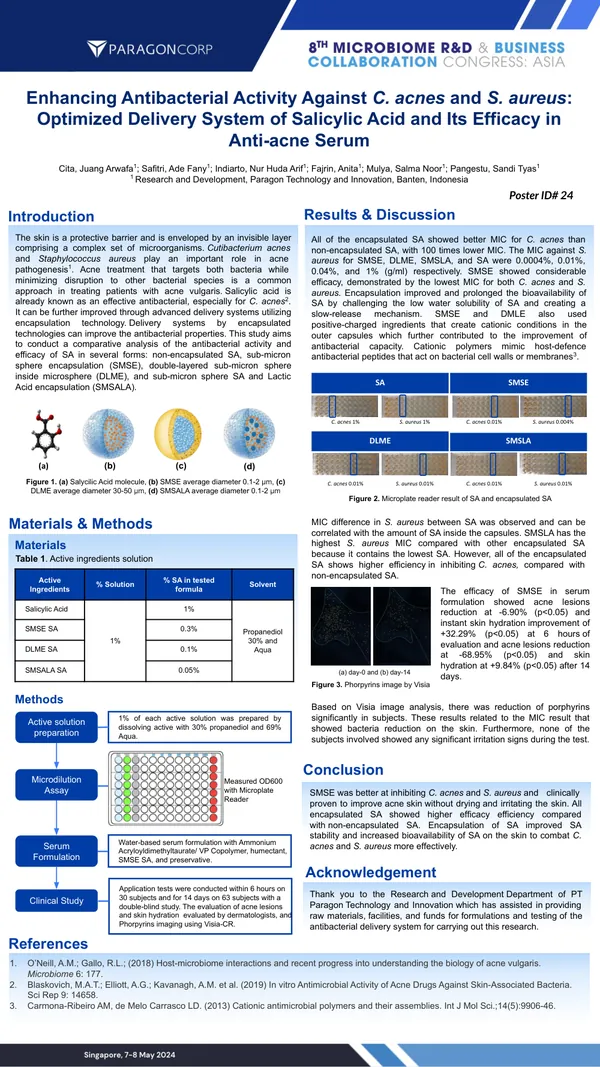
Comparing encapsulated versus non-encapsulated salicylic acid (SA) delivery systems for antibacterial activity against Cutibacterium acnes and Staphylococcus aureus. Encapsulated SA achieved up to 100 times lower MIC against C. acnes, with the SMSE system showing the strongest efficacy. Encapsulation improved and prolonged SA bioavailability through a slow-release mechanism and cationic outer capsules that mimic host-defence antibacterial peptides.
Key findings
- All encapsulated salicylic acid systems achieved a 100 times lower MIC against C. acnes than non-encapsulated salicylic acid
- MIC against S. aureus: SMSE 0.0004%, DLME 0.01%, SMSALA 0.04%, non-encapsulated SA 1%
- SMSE serum reduced acne lesions by 6.90% (p<0.05) and improved skin hydration by 32.29% (p<0.05) at 6 hours
- After 14 days: acne lesions reduced 68.95% (p<0.05) and skin hydration improved 9.84% (p<0.05)
- VISIA image analysis showed a significant reduction in porphyrins
Methods at a glance
- In vitro method
- Microdilution assay, OD600 read on a microplate reader; 1% active solutions prepared in 30% propanediol and 69% aqua
- Formulation
- Water-based serum with ammonium acryloyldimethyltaurate / VP copolymer, humectant, SMSE salicylic acid and preservative
- Instant-effect arm
- 30 subjects, assessed within 6 hours
- Long-term arm
- 63 subjects, 14 days, double-blind
- Assessments
- Dermatologist evaluation of acne lesions and skin hydration, porphyrin imaging with VISIA-CR
Data from the poster
Values reproduced as printed in the source document.
| Delivery system | C. acnes | S. aureus |
|---|---|---|
| SA (free salicylic acid) | 1% | 1% |
| SMSE | 0.01% | 0.004% |
| DLME | 0.01% | 0.01% |
| SMSLA | 0.01% | 0.01% |
Background
The skin is a protective barrier enveloped by an invisible layer comprising a complex set of microorganisms. Cutibacterium acnes and Staphylococcus aureus play an important role in acne pathogenesis, and acne treatment that targets both bacteria while minimising disruption to other bacterial species is a common approach in treating patients with acne vulgaris. Salicylic acid is already known as an effective antibacterial, especially for C. acnes, and it can be further improved through advanced delivery systems using encapsulation technology.
Objective
To conduct a comparative analysis of the antibacterial activity and efficacy of salicylic acid in several forms: non-encapsulated salicylic acid, sub-micron sphere encapsulation (SMSE), double-layered sub-micron sphere inside microsphere (DLME), and sub-micron sphere salicylic acid with lactic acid encapsulation (SMSALA).
Materials and methods
Active ingredient solutions were prepared with salicylic acid in propanediol and aqua as solvents. The tested formulas used salicylic acid at 1% for the non-encapsulated form, SMSE at 0.3% solution, DLME at 0.1% and SMSALA at 0.05%. SMSE has an average particle diameter of 0.1 to 2 μm, DLME 30 to 50 μm and SMSALA 0.1 to 2 μm. Minimum inhibitory concentration (MIC) was determined for C. acnes and S. aureus, and the best-performing system was taken into a serum formulation for clinical evaluation with VISIA imaging at day 0 and day 14.
Results and discussion
All encapsulated salicylic acid systems showed better MIC for C. acnes than non-encapsulated salicylic acid, with a 100 times lower MIC. The MIC against S. aureus for SMSE, DLME, SMSALA and non-encapsulated salicylic acid were 0.0004%, 0.01%, 0.04% and 1% respectively. SMSE showed considerable efficacy, demonstrated by the lowest MIC for both C. acnes and S. aureus. Encapsulation improved and prolonged the bioavailability of salicylic acid by overcoming its low water solubility and creating a slow-release mechanism. SMSE and DLME also use positively charged ingredients that create cationic conditions in the outer capsules, further contributing to improved antibacterial capacity, since cationic polymers mimic host-defence antibacterial peptides that act on bacterial cell walls or membranes. The difference in S. aureus MIC correlates with the amount of salicylic acid inside the capsules: SMSALA has the highest S. aureus MIC because it contains the lowest salicylic acid. The efficacy of SMSE in serum formulation showed an acne lesion reduction of 6.90% (p<0.05) and instant skin hydration improvement of 32.29% (p<0.05) at 6 hours of evaluation, then an acne lesion reduction of 68.95% (p<0.05) and skin hydration improvement of 9.84% (p<0.05) after 14 days. Based on VISIA image analysis, there was a significant reduction of porphyrins in the subjects.
Conclusion
SMSE was better at inhibiting C. acnes and S. aureus and was clinically proven to improve acne skin without drying or irritating the skin. All encapsulated salicylic acid systems showed higher efficacy efficiency compared with non-encapsulated salicylic acid. Encapsulation improved salicylic acid stability and increased its bioavailability on the skin, allowing it to combat C. acnes and S. aureus more effectively.
References
Literature cited by the authors on the source poster.
- 1.O'Neill, A.M. & Gallo, R.L. (2018). Host-microbiome interactions and recent progress into understanding the biology of acne vulgaris. Microbiome 6: 177.
- 2.Blaskovich, M.A.T., Elliott, A.G., Kavanagh, A.M. et al. (2019). In vitro antimicrobial activity of acne drugs against skin-associated bacteria. Scientific Reports 9: 14658.
- 3.Carmona-Ribeiro, A.M. & de Melo Carrasco, L.D. (2013). Cationic antimicrobial polymers and their assemblies. International Journal of Molecular Sciences 14(5): 9906-46.
Acknowledgement
Thank you to the Research and Development Department of PT Paragon Technology and Innovation, which provided raw materials, facilities and funds for the formulation and testing of the antibacterial delivery system used in this research.