 PDF
In Vitro Assessment of Cutibacterium acnes Biofilm Formation from Skincare Regimen Products for Future Acne Biofilm Non-Prescription Treatment
Christianti M.A., Fajrin A., Safitri A.F., Rahmawati Y., Istiqomah N., Fatmawati M., Utami S.T.
Abstract
Acne vulgaris is a complex skin disorder in which Cutibacterium acnes biofilm plays a key role in persistence and antimicrobial tolerance. This in vitro study evaluated how skincare regimen products influence C. acnes biofilm formation, supporting the development of non-prescription approaches to acne biofilm management.
Key findings
- Biofilm reduced by 23.4 ± 7.1% at a 0.2% regimen concentration, after normalisation to bacterial growth and control
- Reduction achieved in a non-toxic manner towards both the skin and bacterial growth
- Active system: 3.45% Sub-Micron Sphere Encapsulation (SMSE) salicylic acid, equal to 1.035% salicylic acid
- Confirmed non-irritating, non-comedogenic and non-acnegenic by dermatological evaluation and single patch test
Methods at a glance
- Study type
- In vitro biofilm inhibition assay
- Test article
- Non-prescription regimen: auto-foam cleanser, toner, face serum, spot treatment
- Active
- 3.45% Sub-Micron Sphere Encapsulation (SMSE) salicylic acid, equal to 1.035% salicylic acid
- Organism
- Cutibacterium acnes
- Concentrations tested
- 0.2%, 1%, 5%
- Safety assessment
- Dermatological evaluation and single patch test; non-irritating, non-comedogenic, non-acnegenic; passed stability testing
Background
Acne vulgaris is a common skin disorder with complex causative factors that correlate with Cutibacterium acnes, a Gram-positive, facultative anaerobic microorganism that thrives in lipid-rich environments. Acne can persist on the skin, with approximately 80% of cases in adult female patients being persistent. This persistence or relapse in acne treatment indicates C. acnes colonisation, which readily forms biofilm and plays an essential role in both the development and the progression of acne. Microbial biofilms are complex surface-attached communities of bacteria held together by a self-produced polymer matrix. Biofilms attach deeply to pores and are very hard to remove, and traditionally biofilm colonisation on the skin requires prescription treatment. A non-prescription skincare regimen can be an alternative that answers the need for persistent or relapsing acne treatment.
Objective
To evaluate the efficacy of a non-prescription skincare regimen consisting of a face serum, toner, spot treatment and auto-foam cleanser in inhibiting C. acnes biofilm formation.
Materials and methods
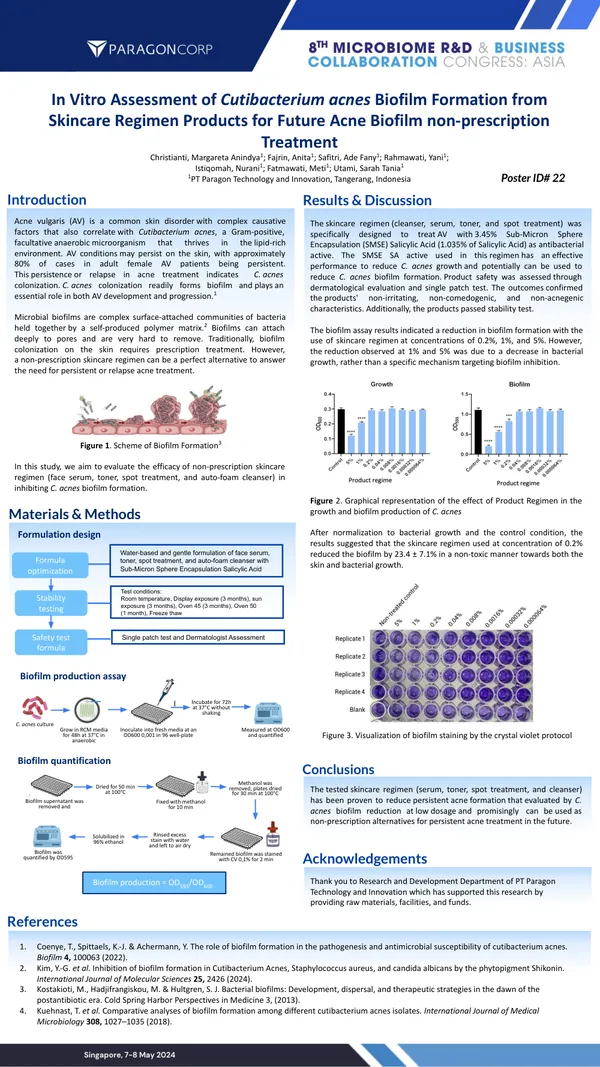
The regimen used water-based, gentle formulations of face serum, toner, spot treatment and auto-foam cleanser built on Sub-Micron Sphere Encapsulation salicylic acid. Formulas went through accelerated stability testing at room temperature, under display exposure and sun exposure for 3 months, in an oven at 45°C for 3 months and 50°C for 1 month, and under freeze thaw cycles, followed by a single patch test and dermatologist assessment. For the biofilm production assay, C. acnes was grown in RCM media for 48 hours at 37°C under anaerobic conditions, then inoculated into fresh media at OD600 0.001 in a 96-well plate and incubated for 72 hours at 37°C without shaking. Remaining biofilm was fixed with methanol, stained with 0.1% crystal violet for 2 minutes, rinsed and solubilised in 96% ethanol, then quantified at OD595. Biofilm production was expressed as OD595 divided by OD600.
Results and discussion
The skincare regimen was designed to treat acne vulgaris with 3.45% Sub-Micron Sphere Encapsulation (SMSE) salicylic acid, equal to 1.035% salicylic acid, as the antibacterial active. The SMSE salicylic acid used in this regimen effectively reduces C. acnes growth and can potentially reduce C. acnes biofilm formation. Product safety was assessed through dermatological evaluation and a single patch test, and the outcomes confirmed the products are non-irritating, non-comedogenic and non-acnegenic. The products also passed stability testing. The biofilm assay indicated a reduction in biofilm formation at concentrations of 0.2%, 1% and 5%. However, the reduction observed at 1% and 5% was due to a decrease in bacterial growth rather than a mechanism that specifically targets biofilm inhibition. After normalisation to bacterial growth and to the control condition, the results showed the skincare regimen at 0.2% reduced biofilm by 23.4 ± 7.1% in a non-toxic manner towards both the skin and bacterial growth.
Conclusion
The tested skincare regimen of serum, toner, spot treatment and cleanser has been proven to reduce persistent acne formation, evaluated through C. acnes biofilm reduction at low dosage, and shows promise as a non-prescription alternative for persistent acne treatment in the future.
References
Literature cited by the authors on the source poster.
- 1.Coenye, T., Spittaels, K.-J. & Achermann, Y. The role of biofilm formation in the pathogenesis and antimicrobial susceptibility of Cutibacterium acnes. Biofilm 4, 100063 (2022).
- 2.Kim, Y.-G. et al. Inhibition of biofilm formation in Cutibacterium acnes, Staphylococcus aureus, and Candida albicans by the phytopigment shikonin. International Journal of Molecular Sciences 25, 2426 (2024).
- 3.Kostakioti, M., Hadjifrangiskou, M. & Hultgren, S. J. Bacterial biofilms: development, dispersal, and therapeutic strategies in the dawn of the postantibiotic era. Cold Spring Harbor Perspectives in Medicine 3, (2013).
- 4.Kuehnast, T. et al. Comparative analyses of biofilm formation among different Cutibacterium acnes isolates. International Journal of Medical Microbiology 308, 1027-1035 (2018).