
 PDF
The Influence of Microbiome-Based Skincare Containing Bifida Ferment Lysate on Acne Healing and Its Potential as an Adjunctive Anti-Acne Treatment
Istiqomah N., Christianti M.A., Solehati, Mulya S.N., Safitri A.F.
Abstract
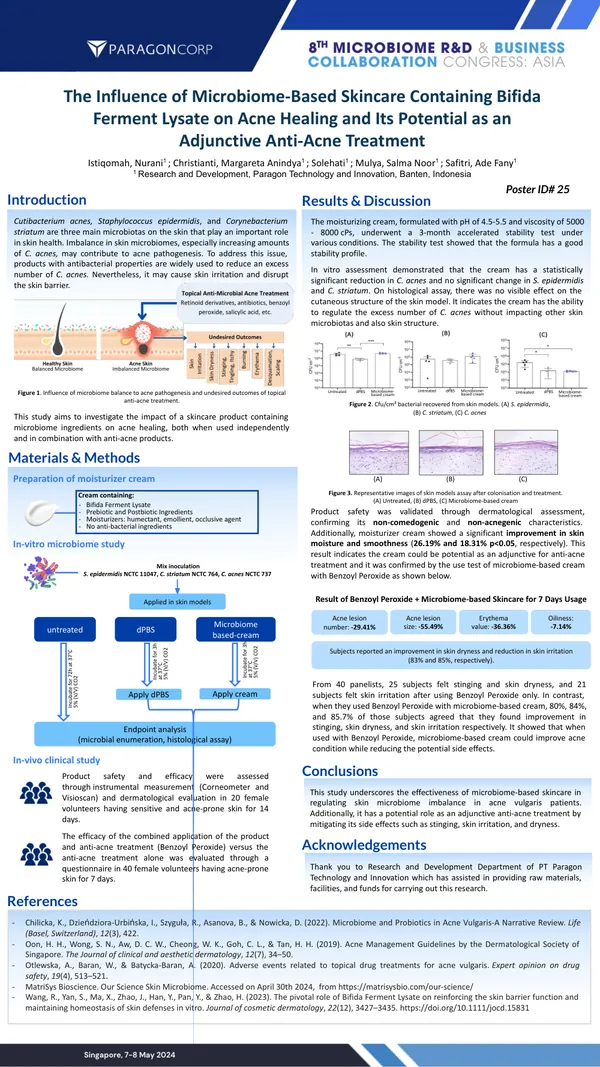
A microbiome-based moisturizing cream containing Bifida Ferment Lysate, evaluated for acne healing and as an adjunctive anti-acne treatment. In vitro assessment showed a statistically significant reduction in C. acnes with no significant change in S. epidermidis or C. striatum and no visible effect on skin structure, indicating it regulates excess C. acnes without disrupting other skin microbiota, while mitigating side effects such as stinging, irritation and dryness.
Key findings
- Statistically significant in vitro reduction of C. acnes with no significant change in S. epidermidis or C. striatum
- No visible effect on the cutaneous structure of the skin model on histological assay
- Skin moisture improved 26.19% and smoothness 18.31% (p<0.05) in 20 volunteers over 14 days
- Combined with benzoyl peroxide over 7 days: acne lesion size -55.49%, lesion count -29.41%, erythema -36.36%, oiliness -7.14%
- 80%, 84% and 85.7% of affected subjects reported improvement in stinging, skin dryness and skin irritation respectively
Methods at a glance
- In vitro model
- Mixed inoculation of Staphylococcus epidermidis NCTC 11047, Corynebacterium striatum NCTC 764 and Cutibacterium acnes NCTC 737
- In vitro arms
- Untreated control, dPBS control, microbiome-based cream
- Incubation
- 3 hours at 37 C and 5% CO2 after application, then 72 hours at 37 C and 5% CO2
- Endpoints
- Microbial enumeration and histological assay
- Clinical arm 1
- 20 female volunteers with sensitive and acne-prone skin, 14 days, Corneometer and Visioscan plus dermatological evaluation
- Clinical arm 2
- 40 female volunteers with acne-prone skin, 7 days, questionnaire comparing the cream plus benzoyl peroxide against benzoyl peroxide alone
Background
Cutibacterium acnes, Staphylococcus epidermidis and Corynebacterium striatum are three main microbiota on the skin that play an important role in skin health. Imbalance in the skin microbiome, especially an increasing amount of C. acnes, may contribute to acne pathogenesis. To address this, products with antibacterial properties are widely used to reduce an excess number of C. acnes. Nevertheless, these products may cause skin irritation and disrupt the skin barrier.
Objective
To investigate the impact of a skincare product containing microbiome ingredients on acne healing, both when used independently and in combination with anti-acne products.
Materials and methods
A moisturizer cream was prepared containing Bifida Ferment Lysate, prebiotic and postbiotic ingredients, and moisturizers covering humectant, emollient and occlusive agents, with no antibacterial ingredients. For the in vitro microbiome study, skin models were mix-inoculated with S. epidermidis NCTC 11047, C. striatum NCTC 764 and C. acnes NCTC 737, incubated for 3 hours at 37°C in 5% CO2, then treated with either dPBS or the microbiome-based cream and incubated for a further 72 hours, followed by microbial enumeration and histological assay. For the in vivo clinical study, product safety and efficacy were assessed through instrumental measurement using Corneometer and Visioscan plus dermatological evaluation in 20 female volunteers with sensitive and acne-prone skin over 14 days. The efficacy of combining the product with benzoyl peroxide versus benzoyl peroxide alone was evaluated through a questionnaire in 40 female volunteers with acne-prone skin over 7 days.
Results and discussion
The moisturizing cream, formulated at pH 4.5 to 5.5 with a viscosity of 5000 to 8000 cPs, underwent a 3-month accelerated stability test under various conditions and showed a good stability profile. In vitro assessment demonstrated a statistically significant reduction in C. acnes and no significant change in S. epidermidis or C. striatum. On histological assay there was no visible effect on the cutaneous structure of the skin model, indicating the cream can regulate the excess number of C. acnes without impacting other skin microbiota or skin structure. Product safety was validated through dermatological assessment, confirming its non-comedogenic and non-acnegenic characteristics. The moisturizer cream showed a significant improvement in skin moisture and smoothness, 26.19% and 18.31% respectively (p<0.05). Combined with benzoyl peroxide over 7 days, acne lesion number fell 29.41%, acne lesion size fell 55.49%, erythema value fell 36.36% and oiliness fell 7.14%. Of 40 panelists, 25 subjects felt stinging and skin dryness and 21 subjects felt skin irritation after using benzoyl peroxide alone. When they used benzoyl peroxide together with the microbiome-based cream, 80%, 84% and 85.7% of those subjects agreed they found improvement in stinging, skin dryness and skin irritation respectively.
Conclusion
This study underscores the effectiveness of microbiome-based skincare in regulating skin microbiome imbalance in acne vulgaris patients. It also has a potential role as an adjunctive anti-acne treatment by mitigating side effects such as stinging, skin irritation and dryness.
References
Literature cited by the authors on the source poster.
- 1.Chilicka, K., Dzieńdziora-Urbińska, I., Szyguła, R., Asanova, B. & Nowicka, D. (2022). Microbiome and probiotics in acne vulgaris: a narrative review. Life (Basel) 12(3), 422.
- 2.Oon, H.H., Wong, S.N., Aw, D.C.W., Cheong, W.K., Goh, C.L. & Tan, H.H. (2019). Acne management guidelines by the Dermatological Society of Singapore. The Journal of Clinical and Aesthetic Dermatology 12(7), 34-50.
- 3.Otlewska, A., Baran, W. & Batycka-Baran, A. (2020). Adverse events related to topical drug treatments for acne vulgaris. Expert Opinion on Drug Safety 19(4), 513-521.
- 4.MatriSys Bioscience. Our science: skin microbiome. Accessed 30 April 2024, from https://matrisysbio.com/our-science/
- 5.Wang, R., Yan, S., Ma, X., Zhao, J., Han, Y., Pan, Y. & Zhao, H. (2023). The pivotal role of Bifida ferment lysate on reinforcing the skin barrier function and maintaining homeostasis of skin defenses in vitro. Journal of Cosmetic Dermatology 22(12), 3427-3435. https://doi.org/10.1111/jocd.15831