
 PDF
Study of a Moisturizer Cream Containing a Combination of Prebiotic, Paraprobiotic and Postbiotic Towards the Skin Microbiome
Istiqomah N., Rosmayanti W., Christianti A.M., Jamal S.
Abstract
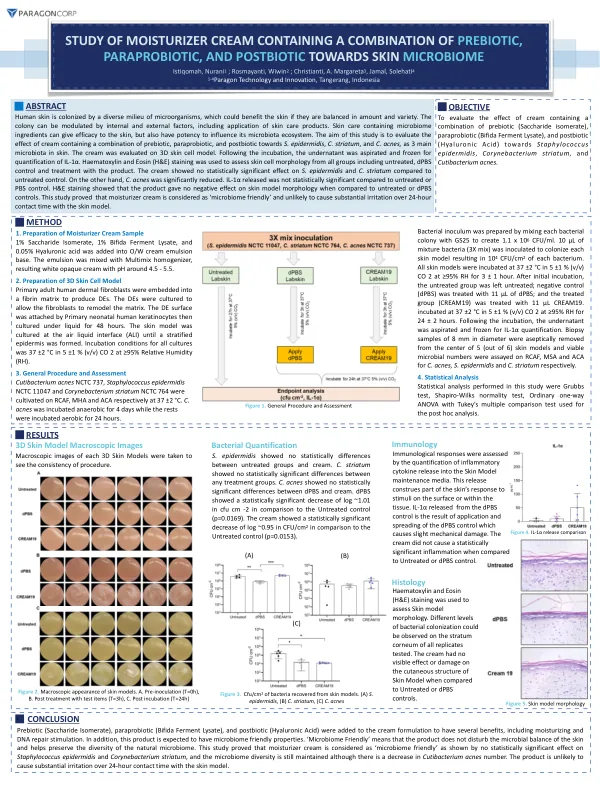
Using a 3D skin-cell model, this study evaluated a cream combining prebiotic (saccharide isomerate), paraprobiotic (Bifida ferment lysate) and postbiotic (hyaluronic acid) against three core skin microbiota (Staphylococcus epidermidis, Corynebacterium striatum and Cutibacterium acnes), assessing IL-1α levels and skin morphology to understand microbiome-balancing skincare.
Key findings
- No statistically significant effect on S. epidermidis or C. striatum compared with the untreated control
- C. acnes significantly reduced, a decrease of log ~0.95 in CFU/cm² versus untreated control (p=0.0153)
- IL-1α release was not statistically significant compared with untreated or dPBS control
- Haematoxylin and eosin staining showed no visible effect or damage to the skin model structure
- Classified as microbiome friendly and unlikely to cause substantial irritation over 24 hours of contact
Methods at a glance
- Model
- 3D skin cell model, 24-hour contact time
- Organisms
- Staphylococcus epidermidis, Corynebacterium striatum and Cutibacterium acnes
- Arms
- Untreated control, dPBS control, moisturizer cream
- Incubation
- C. acnes incubated anaerobically for 4 days; the other organisms incubated separately
- Endpoints
- Microbial quantification, IL-1α from aspirated and frozen undernatant, and haematoxylin and eosin staining for skin cell morphology
- Actives
- Saccharide isomerate as prebiotic, Bifida ferment lysate as paraprobiotic, hyaluronic acid as postbiotic
Background
Human skin is colonised by a diverse milieu of microorganisms, which can benefit the skin when they are balanced in amount and variety. The colony can be modulated by internal and external factors, including the application of skincare products. Skincare containing microbiome ingredients can deliver efficacy to the skin, but it also has the potential to influence the microbiota ecosystem. Microbiome friendly means that a product does not disturb the microbial balance of the skin and helps preserve the diversity of the natural microbiome.
Objective
To evaluate the effect of a cream containing a combination of prebiotic (saccharide isomerate), paraprobiotic (Bifida ferment lysate) and postbiotic (hyaluronic acid) towards Staphylococcus epidermidis, Corynebacterium striatum and Cutibacterium acnes, the three main microbiota on skin.
Materials and methods
1% saccharide isomerate, 1% Bifida ferment lysate and 0.05% hyaluronic acid were added into an oil-in-water cream emulsion base and mixed with a Multimix homogenizer, resulting in a white opaque cream with a pH around 4.5 to 5.5. For the 3D skin cell model, primary adult human dermal fibroblasts were embedded into a fibrin matrix to produce dermal equivalents, which were cultured to allow the fibroblasts to remodel the matrix. Primary neonatal human keratinocytes were attached to the dermal equivalent surface and cultured under liquid for 48 hours, then cultured at the air liquid interface until a stratified epidermis formed, with all cultures incubated at 37 ± 2°C in 5 ± 1% CO2 at at least 95% relative humidity. C. acnes NCTC 737, S. epidermidis NCTC 11047 and C. striatum NCTC 764 were cultivated on RCAF, MHA and ACA respectively at 37 ± 2°C, with C. acnes incubated anaerobically for 4 days and the others aerobically for 24 hours. Bacterial inoculum was prepared to 1.1 x 10⁶ CFU/ml, and 10 μL of the three-species mixture was inoculated onto each skin model, resulting in 10⁴ CFU/cm² of each bacterium. After an initial 3-hour incubation, the untreated group was left untreated, the negative control received 11 μL of dPBS and the treated group received 11 μL of the cream, followed by 24 ± 2 hours of incubation. The undernatant was then aspirated and frozen for IL-1α quantification, and 8 mm biopsy samples were aseptically removed from the centre of five skin models for viable microbial assay on RCAF, MSA and ACA. Statistical analysis used the Grubbs test, the Shapiro-Wilk normality test and ordinary one-way ANOVA with Tukey's multiple comparison test for post hoc analysis.
Results and discussion
S. epidermidis showed no statistically significant difference between the untreated group and the cream, and C. striatum showed no statistically significant differences between any treatment groups. For C. acnes there were no statistically significant differences between dPBS and the cream, while dPBS showed a statistically significant decrease of log ~1.01 in CFU/cm² compared with the untreated control (p=0.0169) and the cream showed a statistically significant decrease of log ~0.95 in CFU/cm² compared with the untreated control (p=0.0153). Immunological response was assessed by quantifying inflammatory cytokine release into the skin model maintenance media. IL-1α released from the dPBS control results from the application and spreading of dPBS causing slight mechanical damage, and the cream did not cause statistically significant inflammation compared with untreated or dPBS control. Haematoxylin and eosin staining was used to assess skin model morphology. Different levels of bacterial colonisation were observed on the stratum corneum of all replicates tested, and the cream had no visible effect or damage on the cutaneous structure of the skin model compared with untreated or dPBS controls.
Conclusion
Prebiotic (saccharide isomerate), paraprobiotic (Bifida ferment lysate) and postbiotic (hyaluronic acid) were added to the cream formulation to deliver several benefits including moisturizing and DNA repair stimulation, and the product was expected to have microbiome friendly properties. This study proved the moisturizer cream is considered microbiome friendly, shown by no statistically significant effect on Staphylococcus epidermidis and Corynebacterium striatum, with microbiome diversity still maintained despite a decrease in Cutibacterium acnes numbers. The product is unlikely to cause substantial irritation over 24 hours of contact time with the skin model.