 PDF
Efficacy of a Topical NAD⁺-Based Serum Against UV-Induced Hyperpigmentation in Sensitive Skin
Fajrin A., Afifah R.M., Christianti M.A., Nirwana H.M., Mulya S.N., Fransisca, Utami S.T., Hendra A., Farisah S., Graciana T.
Abstract
Restoring intracellular NAD⁺ supports cellular energy metabolism, DNA-damage repair and oxidative-stress regulation, key upstream drivers of melanogenesis. In a randomized, single-blind study of 33 participants using a UV-induced melanization model, a topical NAD⁺-based serum was evaluated as a multi-pathway alternative to conventional tyrosinase-focused depigmenting agents.
Key findings
- Randomised, single-blind study in 33 participants using a UV-induced melanization model on the back
- Seven serum formulations compared over 4 weeks, including 0.1% NAD⁺, 10% niacinamide, 2.5% encapsulated cysteamine and 2% alpha-arbutin
- Topical NAD⁺ significantly improved UV-induced pigmentation, with efficacy comparable to conventional brightening agents
- Mechanism spans four upstream pathways: oxidative stress reduction via SIRT1, DNA repair via PARP, inflammation modulation and ATP-driven skin recovery
Methods at a glance
- Design
- Randomized, single-blind study
- Participants
- 33 participants
- Model
- UV-induced melanization model on the back
- Application
- Twice daily for 4 weeks
- Assessments
- ITA (Individual Typology Angle, CM26-dG), Melanin Index (Mexameter MX18) and visual grading by board-certified dermatologists at baseline and week 4
Data from the poster
Values reproduced as printed in the source document.
| Arm | Formulation |
|---|---|
| 1 | Placebo |
| 2 | 0.1% NAD+ |
| 3 | 10% Niacinamide |
| 4 | 2.5% Encapsulated cysteamine |
| 5 | 2% Alpha-arbutin |
| 6 | Commercial serum containing isobutylamido thiazolyl resorcinol (ITR) |
| 7 | Commercial serum containing 2-mercaptonicotinoyl glycine (2-MNG) |
Background
Hyperpigmentation disorders such as melasma and post-inflammatory hyperpigmentation are commonly triggered by ultraviolet exposure. UV radiation stimulates melanogenesis through oxidative stress, inflammatory mediators and activation of the tyrosinase pathway within melanocytes. Conventional topical depigmenting agents, including niacinamide, cysteamine, alpha-arbutin, 2-mercaptonicotinoyl glycine (2-MNG) and isobutylamido thiazolyl resorcinol (ITR), primarily act by inhibiting tyrosinase or melanosome transfer. However, their clinical use may be limited by irritation, stability issues or incomplete control of upstream cellular stress pathways. Nicotinamide adenine dinucleotide (NAD⁺) is a critical coenzyme involved in cellular energy metabolism, DNA damage repair via PARP pathways, regulation of oxidative stress through sirtuin signalling and modulation of inflammation. Recent dermatological research suggests that restoring intracellular NAD⁺ levels may protect keratinocytes and melanocytes from UV-induced oxidative stress, thereby indirectly modulating melanogenesis.
Materials and methods
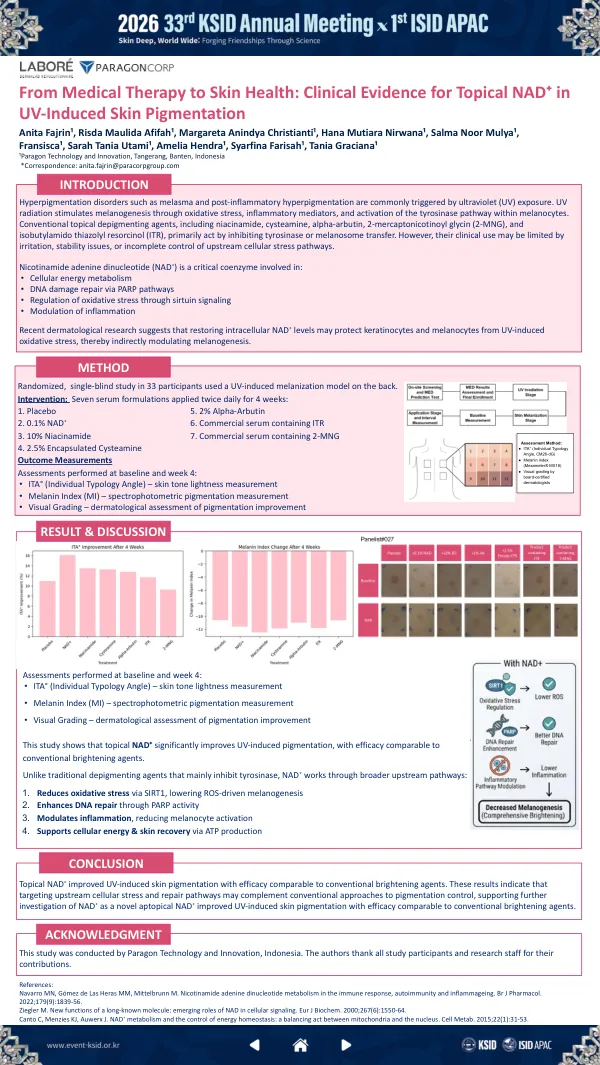
A randomised, single-blind study in 33 participants used a UV-induced melanization model on the back. Seven serum formulations were applied twice daily for 4 weeks: placebo, 0.1% NAD⁺, 10% niacinamide, 2.5% encapsulated cysteamine, 2% alpha-arbutin, a commercial serum containing ITR and a commercial serum containing 2-MNG. Assessments were performed at baseline and week 4 using ITA° (Individual Typology Angle, CM26-dG) for skin tone lightness, melanin index by Mexameter MX18 for spectrophotometric pigmentation measurement, and visual grading by board-certified dermatologists.
Results and discussion
The study shows that topical NAD⁺ significantly improves UV-induced pigmentation, with efficacy comparable to conventional brightening agents. Unlike traditional depigmenting agents that mainly inhibit tyrosinase, NAD⁺ works through broader upstream pathways. It reduces oxidative stress via SIRT1, lowering ROS-driven melanogenesis; enhances DNA repair through PARP activity; modulates inflammation, reducing melanocyte activation; and supports cellular energy and skin recovery via ATP production.
Conclusion
Topical NAD⁺ improved UV-induced skin pigmentation with efficacy comparable to conventional brightening agents. These results indicate that targeting upstream cellular stress and repair pathways may complement conventional approaches to pigmentation control, supporting further investigation of NAD⁺ as a novel approach.
References
Literature cited by the authors on the source poster.
- 1.Navarro, M.N., Gómez de Las Heras, M.M. & Mittelbrunn, M. Nicotinamide adenine dinucleotide metabolism in the immune response, autoimmunity and inflammageing. British Journal of Pharmacology. 2022;179(9):1839-56.
- 2.Ziegler, M. New functions of a long-known molecule: emerging roles of NAD in cellular signaling. European Journal of Biochemistry. 2000;267(6):1550-64.
- 3.Canto, C., Menzies, K.J. & Auwerx, J. NAD+ metabolism and the control of energy homeostasis: a balancing act between mitochondria and the nucleus. Cell Metabolism. 2015;22(1):31-53.
Acknowledgement
This study was conducted by Paragon Technology and Innovation, Indonesia. The authors thank all study participants and research staff for their contributions.