 PDF
β-Carotene as an Antioxidant Strategy to Improve Brightening Sunscreen Efficacy Against Blue Light–Induced Melanogenesis
Nirwana H.M., Fajrin A., Mulya S.N., Cita J.A., Christianti M.A., Utami S.T., Hendra A., Graciana T.
Abstract
Visible blue light (400–500 nm) penetrates deep into the skin and drives sustained melanogenesis. Incorporating β-carotene into a brightening sunscreen increased its blue light-protection value, comparable to iron oxide, and delivered a significant anti-pigmentation effect in women with sensitive skin, supporting multifunctional sunscreens that combine UV filters, brightening actives and antioxidants.
Key findings
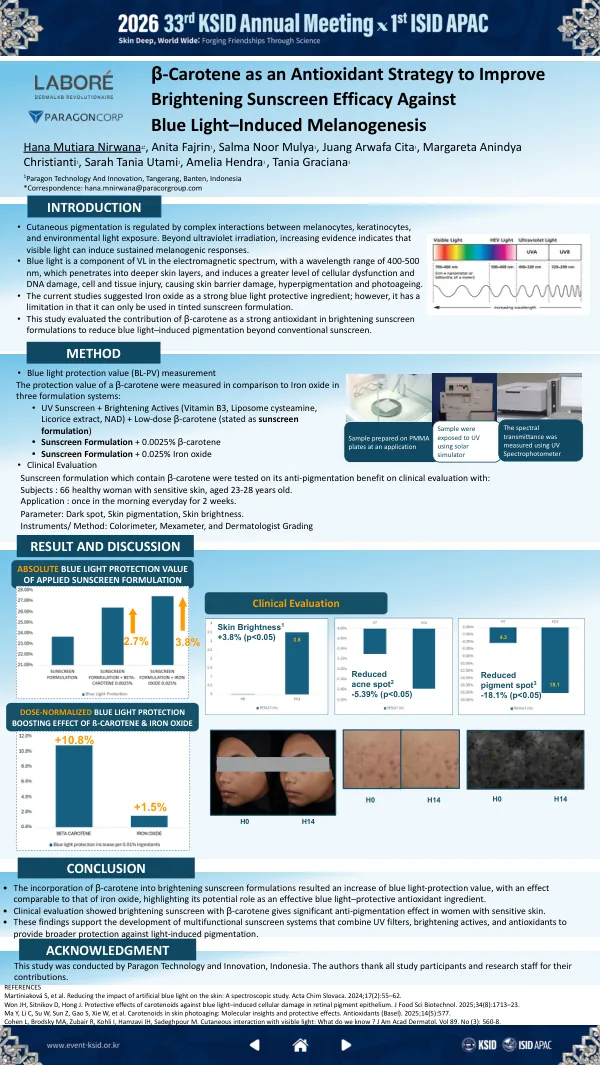
- Absolute blue light protection value rose from 2.7% for the base sunscreen formulation to 3.8% with β-carotene
- Dose-normalised blue light protection boosting effect of +10.8% for β-carotene versus +1.5% for iron oxide
- Clinical evaluation in 66 women with sensitive skin: skin brightness +3.8% (p<0.05)
- Pigment spots reduced 18.1% (p<0.05) and acne spots reduced 5.39% (p<0.05) after 14 days
Methods at a glance
- Participants
- 66 healthy women with sensitive skin, 23 to 28 years old
- Application
- Once every morning for 2 weeks
- Parameters
- Dark spot, skin pigmentation, skin brightness
- Instruments
- Colorimeter, Mexameter and dermatologist grading
Data from the poster
Values reproduced as printed in the source document.
| Parameter | Change at Day 14 | Significance |
|---|---|---|
| Skin brightness | +3.8% | p<0.05 |
| Acne spot | -5.39% | p<0.05 |
| Pigment spot | -18.1% | p<0.05 |
Background
Cutaneous pigmentation is regulated by complex interactions between melanocytes, keratinocytes and environmental light exposure. Beyond ultraviolet irradiation, increasing evidence indicates that visible light can induce sustained melanogenic responses. Blue light is a component of visible light in the electromagnetic spectrum, with a wavelength range of 400 to 500 nm, which penetrates into deeper skin layers and induces a greater level of cellular dysfunction and DNA damage, cell and tissue injury, causing skin barrier damage, hyperpigmentation and photoageing. Current studies suggest iron oxide is a strong blue light protective ingredient, but it has the limitation that it can only be used in tinted sunscreen formulations.
Objective
To evaluate the contribution of β-carotene as a strong antioxidant in brightening sunscreen formulations, in order to reduce blue light induced pigmentation beyond what conventional sunscreen achieves.
Materials and methods
Blue light protection value (BL-PV) was measured for β-carotene in comparison to iron oxide across three formulation systems: a UV sunscreen combined with brightening actives (vitamin B3, liposome cysteamine, licorice extract and NAD) plus low-dose β-carotene, referred to as the sunscreen formulation; the sunscreen formulation with 0.0025% β-carotene; and the sunscreen formulation with 0.025% iron oxide. Samples were prepared on PMMA plates, exposed to UV using a solar simulator, and spectral transmittance was measured using a UV spectrophotometer. For clinical evaluation, the sunscreen formulation containing β-carotene was tested for anti-pigmentation benefit in 66 healthy women with sensitive skin aged 23 to 28, applied once every morning for 2 weeks. Parameters were dark spots, skin pigmentation and skin brightness, measured by colorimeter, Mexameter and dermatologist grading.
Results and discussion
The absolute blue light protection value of the applied sunscreen formulation rose from 2.7% to 3.8% with the addition of β-carotene. On a dose-normalised basis, the blue light protection boosting effect was +10.8% for β-carotene compared with +1.5% for iron oxide. Clinical evaluation over 14 days showed skin brightness improved by 3.8% (p<0.05), pigment spots reduced by 18.1% (p<0.05) and acne spots reduced by 5.39% (p<0.05).
Conclusion
Incorporating β-carotene into brightening sunscreen formulations increased the blue light protection value, with an effect comparable to that of iron oxide, highlighting its potential role as an effective blue light protective antioxidant ingredient. Clinical evaluation showed a brightening sunscreen with β-carotene gives a significant anti-pigmentation effect in women with sensitive skin. These findings support the development of multifunctional sunscreen systems that combine UV filters, brightening actives and antioxidants to provide broader protection against light-induced pigmentation.
References
Literature cited by the authors on the source poster.
- 1.Martiniaková, S., et al. Reducing the impact of artificial blue light on the skin: a spectroscopic study. Acta Chimica Slovaca. 2024;17(2):55-62.
- 2.Won, J.H., Sitnikov, D. & Hong, J. Protective effects of carotenoids against blue light-induced cellular damage in retinal pigment epithelium. Journal of Food Science and Biotechnology. 2025;34(8):1713-23.
- 3.Ma, Y., Li, C., Su, W., Sun, Z., Gao, S., Xie, W., et al. Carotenoids in skin photoaging: molecular insights and protective effects. Antioxidants (Basel). 2025;14(5):577.
- 4.Cohen, L., Brodsky, M.A., Zubair, R., Kohli, I., Hamzavi, I.H. & Sadeghpour, M. Cutaneous interaction with visible light: what do we know? Journal of the American Academy of Dermatology. Vol 89, No 3: 560-8.