 PDF
Nicotinamide Adenine Dinucleotide: A Promising Nicotinamide Derivative for Potent Skin Brightening Applications
Afifah R.M., Fajrin A., Fransisca, Christianti M.A.
Laboré Skin Research and Innovation Center
Abstract
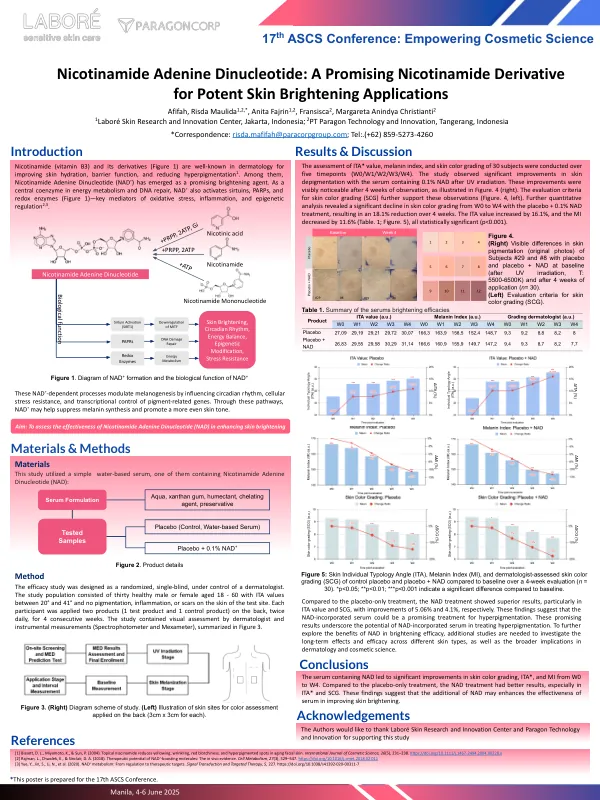
Nicotinamide (vitamin B3) derivatives are established in dermatology for hydration, barrier support and pigmentation control. NAD⁺, a central coenzyme in energy metabolism and DNA repair, also activates sirtuins, PARPs and redox enzymes. This randomized, single-blind, dermatologist-controlled study evaluated NAD⁺ as a potent skin-brightening agent.
Key findings
- Skin color grading fell 18.1% from week 0 to week 4 with the 0.1% NAD⁺ serum (p<0.001)
- ITA value increased 16.1% and melanin index decreased 11.6%, both statistically significant (p<0.001)
- Versus placebo alone, the NAD⁺ treatment improved ITA value by 5.06% and skin color grading by 4.1%
- 30 healthy subjects aged 18 to 60 with baseline ITA between 20° and 41°, twice daily for 4 weeks
Methods at a glance
- Participants
- n = 30
- Design
- Within-subject comparison; each participant received one test product and one control product on the back, on 3 cm x 3 cm sites
- Application
- Twice daily for 4 consecutive weeks
- Arms
- Placebo (control, water-based serum) versus placebo + 0.1% NAD+
- Baseline
- After UV irradiation at colour temperature 5500 to 6500 K
- Assessments
- Individual Typology Angle (ITA), Melanin Index (MI) and dermatologist-assessed skin colour grading (SCG) at W0 and W4
Data from the poster
Values reproduced as printed in the source document.
| Measure | Change W0 to W4, placebo + NAD+ | Advantage over placebo |
|---|---|---|
| Skin colour grading (SCG) | -18.1% | +4.1% |
| Individual Typology Angle (ITA) | +16.1% | +5.06% |
Background
Nicotinamide (vitamin B3) and its derivatives are well known in dermatology for improving skin hydration and barrier function and for reducing hyperpigmentation. Among them, Nicotinamide Adenine Dinucleotide (NAD⁺) has emerged as a promising brightening agent. As a central coenzyme in energy metabolism and DNA repair, NAD⁺ also activates sirtuins, PARPs and redox enzymes, which are key mediators of oxidative stress, inflammation and epigenetic regulation. These NAD⁺-dependent processes modulate melanogenesis by influencing circadian rhythm, cellular stress resistance and transcriptional control of pigment-related genes. Through these pathways, NAD⁺ may help suppress melanin synthesis and promote a more even skin tone.
Objective
To assess the effectiveness of Nicotinamide Adenine Dinucleotide in enhancing skin brightening.
Materials and methods
The study used a simple water-based serum consisting of aqua, xanthan gum, a humectant, a chelating agent and a preservative. The tested samples were the placebo water-based serum as control and the same placebo with 0.1% NAD⁺. The efficacy study was designed as randomised and single-blind under the control of a dermatologist. The study population consisted of 30 healthy males or females aged 18 to 60 with ITA values between 20° and 41° and no pigmentation, inflammation or scars on the skin of the test site. Each participant applied two products, one test product and one control product, on the back twice daily for 4 consecutive weeks. Assessment combined visual evaluation by a dermatologist with instrumental measurements using a spectrophotometer and Mexameter, on 3 cm by 3 cm skin sites.
Results and discussion
ITA value, melanin index and skin color grading were assessed in 30 subjects across five timepoints from week 0 to week 4. The study observed significant improvements in skin depigmentation with the serum containing 0.1% NAD⁺ after UV irradiation, visibly noticeable after 4 weeks of observation. Quantitative analysis revealed a significant decline in skin color grading from week 0 to week 4 with the placebo plus 0.1% NAD⁺ treatment, an 18.1% reduction over 4 weeks. The ITA value increased by 16.1% and the melanin index decreased by 11.6%, all statistically significant at p<0.001. Compared with the placebo-only treatment, the NAD⁺ treatment showed superior results, particularly in ITA value and skin color grading, with improvements of 5.06% and 4.1% respectively. To further explore the benefits of NAD⁺ in brightening efficacy, additional studies are needed to investigate long-term effects and efficacy across different skin types.
Conclusion
The serum containing NAD⁺ led to significant improvements in skin color grading, ITA and melanin index from week 0 to week 4. Compared with the placebo-only treatment, the NAD⁺ treatment had better results, especially in ITA and skin color grading. These findings suggest that the addition of NAD⁺ may enhance the effectiveness of a serum in improving skin brightening.
References
Literature cited by the authors on the source poster.
- 1.Bissett, D.L., Miyamoto, K. & Sun, P. (2004). Topical niacinamide reduces yellowing, wrinkling, red blotchiness, and hyperpigmented spots in aging facial skin. International Journal of Cosmetic Science, 26(5), 231-238. https://doi.org/10.1111/j.1467-2494.2004.00228.x
- 2.Rajman, L., Chwalek, K. & Sinclair, D.A. (2018). Therapeutic potential of NAD+-boosting molecules: the in vivo evidence. Cell Metabolism, 27(3), 529-547. https://doi.org/10.1016/j.cmet.2018.02.011
- 3.Yue, Y., Jin, S., Li, N., et al. (2020). NAD+ metabolism: from regulation to therapeutic targets. Signal Transduction and Targeted Therapy, 5, 227. https://doi.org/10.1038/s41392-020-00311-7