 PDF
Evaluation of the Antiperspirant and Antibacterial Deodorant: An Integrated Approach to Sweat and Malodor Control on Axillary Skin
Indiarto N.H.A., Pangestu S.T., Safitri A.F., Jamal S., Hafidz Sukamto R., Khosasih H.V.X.
Abstract
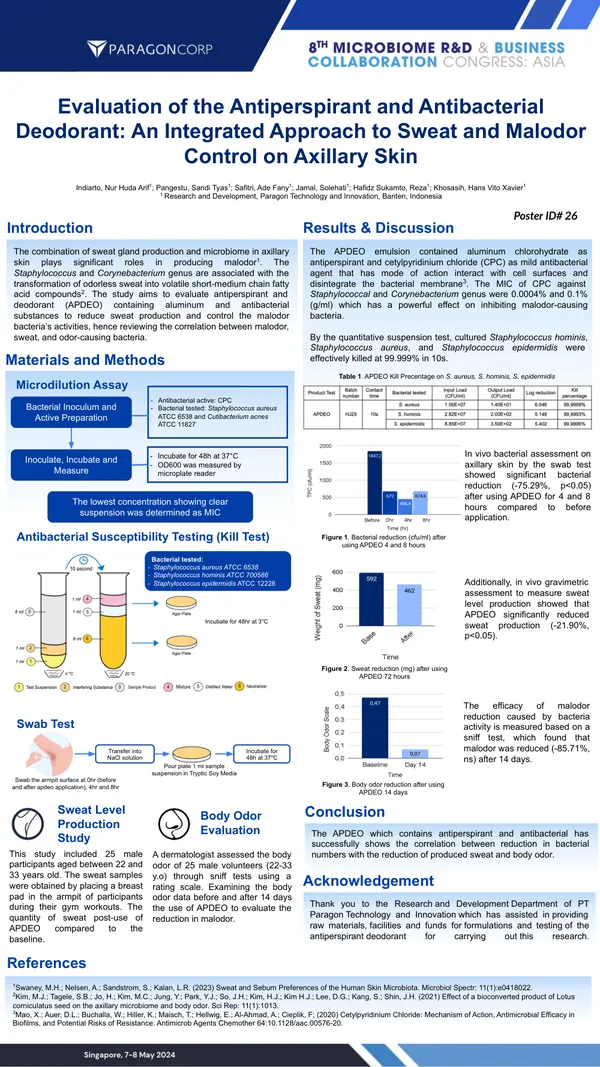
Evaluation of an antiperspirant and antibacterial deodorant (APDEO) containing aluminum chlorohydrate and cetylpyridinium chloride (CPC) for sweat and malodor control on axillary skin. CPC disrupts bacterial membranes with a potent effect on malodor-causing Staphylococcus and Corynebacterium, and a quantitative suspension test showed 99.999% kill of key Staphylococcus species within 10 seconds.
Key findings
- CPC MIC of 0.0004% against the Staphylococcus genus and 0.1% against the Corynebacterium genus
- Quantitative suspension test killed S. hominis, S. aureus and S. epidermidis at 99.999% in 10 seconds
- In vivo swab test showed axillary bacteria reduced 75.29% (p<0.05) at 4 and 8 hours after application
- Gravimetric assessment showed sweat production reduced 21.90% (p<0.05)
- Sniff test showed malodor reduced 85.71% after 14 days of use
Methods at a glance
- Microdilution assay
- Cetylpyridinium chloride against Staphylococcus aureus ATCC 6538 and Cutibacterium acnes ATCC 11827; 48 hours at 37 C; OD600 by microplate reader
- Kill test organisms
- Staphylococcus aureus ATCC 6538, Staphylococcus hominis ATCC 700586, Staphylococcus epidermidis ATCC 12228
- Swab test
- Axillary surface swabbed at 0 hours before and after application, then at 4 and 8 hours; pour plate in tryptic soy media, 48 hours at 37 C
- Sweat level study
- 25 male participants, 22 to 33 years old; gravimetric measurement using a breast pad worn in the armpit during gym workouts
- Body odor evaluation
- Dermatologist sniff test with a rating scale in 25 male volunteers, 22 to 33 years old, before and after 14 days of use
Background
The combination of sweat gland production and the microbiome in axillary skin plays a significant role in producing malodor. The Staphylococcus and Corynebacterium genera are associated with the transformation of odourless sweat into volatile short and medium chain fatty acid compounds.
Objective
To evaluate an antiperspirant and deodorant (APDEO) containing aluminum and antibacterial substances to reduce sweat production and control the activity of malodor-causing bacteria, and in doing so review the correlation between malodor, sweat and odor-causing bacteria.
Materials and methods
A microdilution assay determined the MIC of the antibacterial active cetylpyridinium chloride (CPC) against Staphylococcus aureus ATCC 6538 and Cutibacterium acnes ATCC 11827, incubated for 48 hours at 37°C with OD600 measured on a microplate reader. Antibacterial susceptibility (kill test) was performed against S. aureus ATCC 6538, Staphylococcus hominis ATCC 700586 and Staphylococcus epidermidis ATCC 12228. A swab test sampled the armpit surface before and after APDEO application and at 4 and 8 hours, with samples transferred into NaCl solution, pour-plated in tryptic soy media and incubated for 48 hours at 37°C. A sweat level production study included 25 male participants aged 22 to 33, with sweat samples collected using a breast pad placed in the armpit during gym workouts and compared against baseline. For body odor evaluation, a dermatologist assessed 25 male volunteers aged 22 to 33 through sniff tests using a rating scale, before and after 14 days of APDEO use.
Results and discussion
The APDEO emulsion contained aluminum chlorohydrate as the antiperspirant and cetylpyridinium chloride as a mild antibacterial agent whose mode of action is to interact with cell surfaces and disintegrate the bacterial membrane. The MIC of CPC against the Staphylococcus and Corynebacterium genera was 0.0004% and 0.1% respectively, a powerful effect on inhibiting malodor-causing bacteria. By quantitative suspension test, cultured S. hominis, S. aureus and S. epidermidis were effectively killed at 99.999% in 10 seconds. In vivo bacterial assessment on axillary skin by swab test showed a significant bacterial reduction of 75.29% (p<0.05) after using APDEO for 4 and 8 hours compared with before application. In vivo gravimetric assessment of sweat level production showed APDEO significantly reduced sweat production by 21.90% (p<0.05). The efficacy of malodor reduction, measured by sniff test, found malodor was reduced by 85.71% after 14 days.
Conclusion
The APDEO containing both antiperspirant and antibacterial actives successfully demonstrates the correlation between a reduction in bacterial numbers and the reduction of produced sweat and body odor.
References
Literature cited by the authors on the source poster.
- 1.Swaney, M.H., Nelsen, A., Sandstrom, S. & Kalan, L.R. (2023). Sweat and sebum preferences of the human skin microbiota. Microbiology Spectrum 11(1): e0418022.
- 2.Kim, M.J., Tagele, S.B., Jo, H., Kim, M.C., Jung, Y., Park, Y.J., So, J.H., Kim, H.J., Kim, H.J., Lee, D.G., Kang, S. & Shin, J.H. (2021). Effect of a bioconverted product of Lotus corniculatus seed on the axillary microbiome and body odor. Scientific Reports 11(1): 1013.
- 3.Mao, X., Auer, D.L., Buchalla, W., Hiller, K., Maisch, T., Hellwig, E., Al-Ahmad, A. & Cieplik, F. (2020). Cetylpyridinium chloride: mechanism of action, antimicrobial efficacy in biofilms, and potential risks of resistance. Antimicrobial Agents and Chemotherapy 64: 10.1128/aac.00576-20.
Acknowledgement
Thank you to the Research and Development Department of PT Paragon Technology and Innovation, which provided raw materials, facilities and funds for the formulation and testing of the antiperspirant deodorant used in this research.